How Do You Lose a Paragraph?
 Hazel Johnson
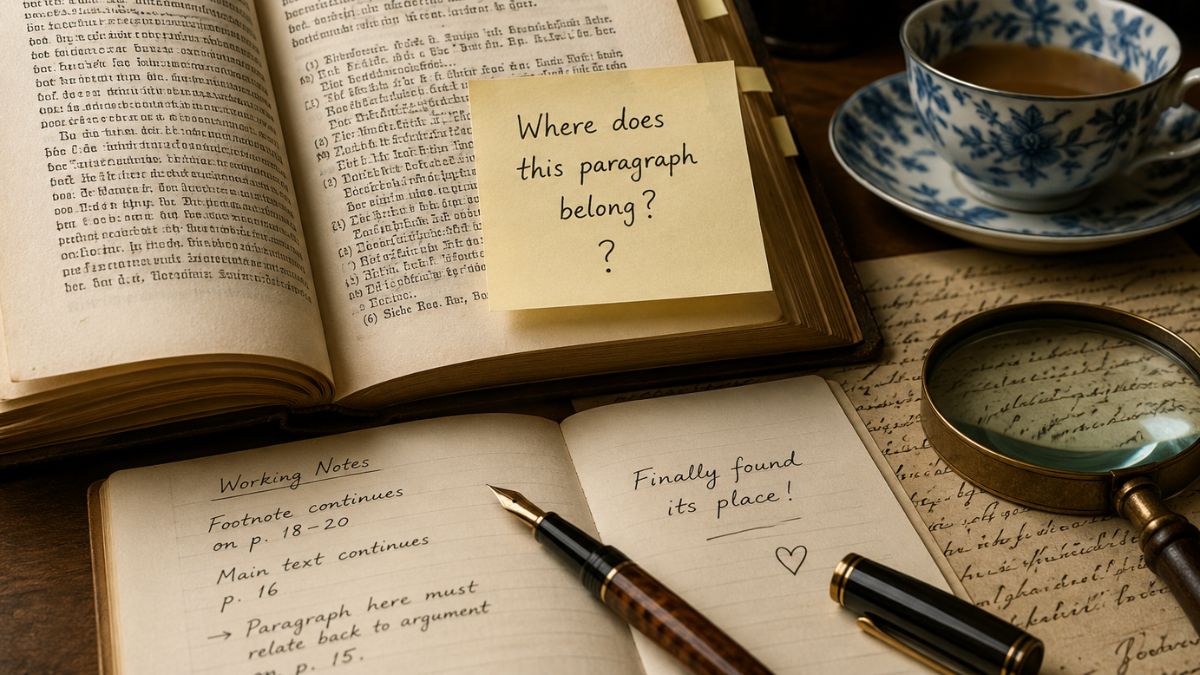
How do you lose a paragraph from a 300-year-old book? Today's research became an unexpected lesson in historical detective work.
This afternoon I found myself trying to explain to my husband how it was possible to lose a paragraph from a book written nearly three hundred years ago.
He looked at me rather puzzled.
"How can you lose a paragraph?" he asked.
Well, it's a perfectly reasonable question, isn't it?
The answer, of course, is that I hadn't actually lost it. I knew the paragraph existed. I'd translated it from German into English weeks ago.
The problem was that, as I assembled everything into what is slowly becoming a book, I could no longer work out where it belonged.
That might sound a bit strange, until you remember that old books don't always behave like modern ones.
Old books don't behave like modern ones
The source I was working on today was printed in the eighteenth century, and its author seemed perfectly happy to interrupt himself with long rambling footnotes that wandered across several pages before eventually returning to where they'd started.
At one point I found myself happily following the main text, only to realise that the footnote had quietly wandered off in one direction while the main text had carried on in another!
For a while, I genuinely had a paragraph looking for its home. Just floating on the screen in front of me in the middle of an A4 page!
Eventually, after going back to the original pages and patiently retracing the author's steps, everything fell back into place. The paragraph hadn't disappeared at all. It had simply become separated from the argument it belonged to.
Behind the pages
It reminded me that historical research isn't just about discovering new things.
Sometimes it's about patiently helping old things make sense again ('patiently' being the operative word, and something I find very challenging!).
It's easy to imagine that translating an old book is simply a matter of changing one language into another. In reality, there's often a surprising amount of detective work involved:
🧩 Letters that no longer resemble modern lettering.
🧩 A misplaced footnote. A forgotten reference.
🧩 Three different spellings of the same name.
🧩 Towns and cities that change name over centuries.
None of those things are especially dramatic, but together they're all part of helping a historical source tell its story clearly.
Those little puzzles are rarely visible in the finished book. By the time a reader opens it, everything should simply flow. That's exactly as it should be.
But every now and then, I think it's rather nice to pause and share a glimpse of the journey behind the pages.
And, for anyone wondering...
Yes.
I'm pleased to report that, by the end of the afternoon, the paragraph finally found its rightful place, thankfully!
— Hazel
The Hamelin Project
The Hamelin Project Research Journal documents the ongoing process of researching the history behind the Pied Piper of Hamelin through original sources, archival research, translations, and historical scholarship.